Ingredient profile
Vitamin E in Prostacyl: The Synthetic Form, the Dose and the SELECT Trial
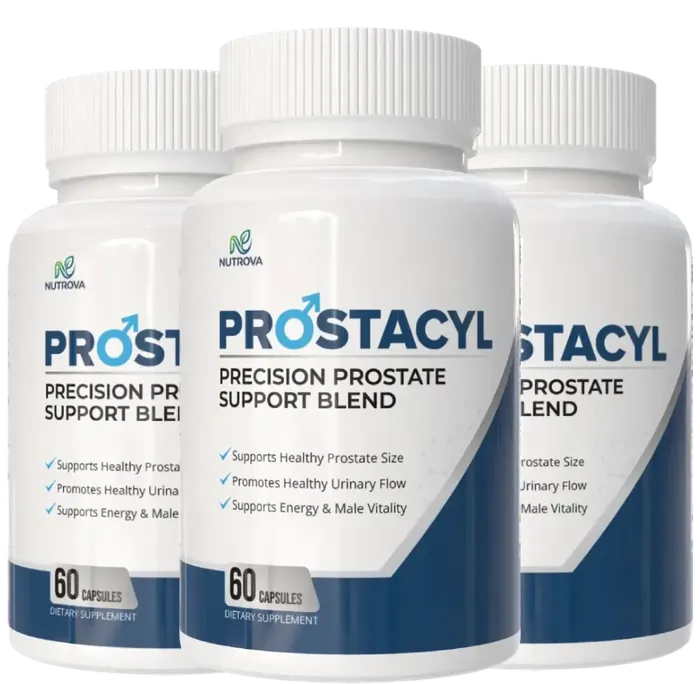
Prostacyl prints 25 mg of vitamin E as dl-alpha tocopheryl acetate, the synthetic form, and calls it 167% of the Daily Value. The NIH sets the adult RDA at 15 mg and the upper limit at 1,000 mg (NIH ODS: Vitamin E). In the SELECT trial, 400 IU (about 180 mg) a day raised prostate cancer risk by 17% (NCI: SELECT trial results Q&A). Prostacyl's dose is far lower.
Written by the Prostacyl editorial teamUpdated
The basics
What kind of vitamin E is in Prostacyl?
Prostacyl uses dl-alpha tocopheryl acetate. That is synthetic vitamin E, made in a lab rather than taken from plant oils.
The NIH Office of Dietary Supplements explains the naming. Natural vitamin E is written d-alpha-tocopherol. The synthetic version is written dl-alpha-tocopherol, also called all-rac (NIH ODS: Vitamin E).
Vitamin E is an antioxidant that most adults get enough of from food. Prostacyl lists it first on the Supplement Facts panel, ahead of vitamin B6.
This form matters for one more reason. SELECT, the largest prostate trial of vitamin E, used exactly this synthetic acetate form (NCI: SELECT trial results Q&A).
Label math
Is the 167% Daily Value for Prostacyl's vitamin E accurate?
It may be generous. The 167% figure treats 25 mg as if all of it counts as full-strength vitamin E, and synthetic vitamin E is only about half as active.
The NIH's own conversion says 1 mg of natural vitamin E equals 1 mg of alpha-tocopherol, while 2 mg of synthetic equals only 1 mg (NIH ODS: Vitamin E). If the label's 25 mg is the weight of the synthetic form, the body sees roughly 12.5 mg. That would be about 83% of the 15 mg Daily Value, not 167%.
| How the 25 mg is counted | Alpha-tocopherol the body can use | Share of the 15 mg Daily Value |
|---|---|---|
| As printed (label's basis) | 25 mg | 167% |
| As synthetic weight, at half activity | About 12.5 mg | About 83% |
| For comparison: natural d-alpha, 25 mg | 25 mg | 167% |
This is our reading of the label, not a finding about the product. Only Nutrova can say which basis it used. The FDA explains how a %DV is supposed to be worked out in its labeling guide (FDA Labeling Guide ch. IV: % Daily Value).
At a glance
Prostacyl's vitamin E in five numbers
Evidence
What did the SELECT trial find about vitamin E and prostate cancer?
It found more prostate cancer, not less. Men who took 400 IU of synthetic vitamin E a day had a 17% higher risk than men on placebo, the National Cancer Institute reports (NCI: SELECT trial results Q&A).
The design
SELECT enrolled 35,533 healthy men aged 50 or older. They took vitamin E, selenium, both, or a placebo. The vitamin E was 400 IU a day of dl-alpha tocopheryl acetate (JAMA 2011: Vitamin E and prostate cancer).
The early stop
Men were told to stop their study pills in October 2008. Researchers kept following them afterward (NCI: SELECT trial results Q&A).
The 2011 result
Writing in JAMA in 2011, the team reported 620 prostate cancers on vitamin E against 529 on placebo. The hazard ratio was 1.17, a statistically significant rise (JAMA 2011: Vitamin E and prostate cancer).
In plain numbers, NCI puts it at 76 cancers per 1,000 men on vitamin E over about 7 years, against 65 per 1,000 on placebo. That is 11 extra cases per 1,000 men (NCI: SELECT trial results Q&A).
"Dietary supplementation with vitamin E significantly increased the risk of prostate cancer among healthy men" (JAMA 2011: Vitamin E and prostate cancer). NCI's advice since then: do not take vitamin E supplements to prevent cancer (NCI: SELECT trial results Q&A).
Dose check
How does Prostacyl's vitamin E compare with the SELECT dose?
Prostacyl's 25 mg is about one-seventh of the roughly 180 mg used in SELECT, or less if the label counts the synthetic weight. The NIH lists SELECT's 400 IU as about 180 mg (NIH ODS: Vitamin E).
- Compared with the RDA: 25 mg is above the 15 mg adults need each day.
- Compared with SELECT: about 14% or less of the dose linked with higher prostate cancer risk.
- Compared with the upper limit: 2.5% of the 1,000 mg the NIH sets as the adult ceiling (NIH ODS: Vitamin E).
SELECT did not test small doses, so it cannot say whether 25 mg carries any risk. It does show that more vitamin E is not better for the prostate.
Safety
Does vitamin E carry other risks besides prostate cancer?
Yes, at high doses. The National Cancer Institute notes that in two large trials, men taking vitamin E had more hemorrhagic strokes, the bleeding kind, than men on placebo (NCI PDQ: Prostate supplements (patient)).
Blood thinners
Large doses of vitamin E taken with warfarin may raise bleeding risk, probably above 400 IU a day, the NIH says (NIH ODS: Vitamin E). Prostacyl's saw palmetto and grape seed also carry bleeding cautions.
Other products
Multivitamins, eye formulas and "antioxidant" blends often add vitamin E. Read every label you take and add up the milligrams or IU.
Show the Prostacyl label to your doctor or pharmacist before you start, so they can weigh all three bleeding cautions together.
For a full list of reported reactions across all nine ingredients, see the Prostacyl side effects page.
Food first
Do men over 50 need extra vitamin E from a supplement?
Usually not. The RDA is 15 mg a day for everyone 14 and older, with no extra amount for older men (NIH ODS: Vitamin E).
Nuts, seeds and vegetable oils are the classic food sources (NIH ODS: Vitamin E), and a handful of almonds or sunflower seeds goes a long way. No research points to the prostate as a reason to take more.
A daily multivitamin may already supply vitamin E, so Prostacyl would double it up. The overlap is unlikely to reach the upper limit, and it adds little.
Our view
Is the vitamin E in Prostacyl a concern or a benefit?
Neither, for most men. The dose is modest and well below the amount tied to harm in SELECT, but it brings no shown prostate benefit.
Pros
- Form and amount both printed
- Far below the SELECT dose and the upper limit
- Close to normal daily needs
Cons
- Synthetic form, about half as active as natural
- The 167% DV may overstate real activity
- Conflicts with a "natural ingredients" badge
- No prostate benefit in large trials
The brand shows a "natural ingredients" badge, but synthetic vitamin E is not natural. Our Supplement Facts guide walks through every printed line.
| Label name | Vitamin E (as dl-alpha tocopheryl acetate) |
|---|---|
| What it is | dl-alpha tocopheryl acetate (synthetic) · Vitamin |
| Position on the label | Printed with its own amount |
| Amount per serving (2 capsules) | 25 mg, printed (167% DV) |
| Amount used in research | RDA 15 mg a day; upper limit 1,000 mg; SELECT used 400 IU (about 180 mg) |
| Strength of evidence | No prostate benefit; high doses raised risk |
| Why it is used | An antioxidant vitamin; this is the synthetic form |
| Main caution | In the SELECT trial, 400 IU a day raised prostate cancer risk by 17%; this dose is far lower. |
FAQ
Vitamin E in Prostacyl: common questions
What does dl-alpha tocopheryl acetate mean on a supplement label?
It means synthetic vitamin E. The NIH Office of Dietary Supplements explains that the dl- (all-rac) prefix marks the lab-made form, while natural vitamin E reads d-alpha (NIH ODS: Vitamin E). Synthetic vitamin E is about half as active, milligram for milligram, so 25 mg acts like roughly 12.5 mg.
What did the SELECT trial find about vitamin E?
It found a 17% higher prostate cancer risk in men taking 400 IU of synthetic vitamin E a day, compared with placebo (NCI: SELECT trial results Q&A). The trial followed 35,533 men, and JAMA published the result in 2011 (JAMA 2011: Vitamin E and prostate cancer). Prostacyl's 25 mg is about one-seventh of that dose, and small doses were not tested.
Should men take vitamin E for prostate health?
Not for cancer prevention, according to the National Cancer Institute, which advises against vitamin E supplements for that purpose (NCI: SELECT trial results Q&A). No large trial has shown a prostate benefit. Most men can meet the 15 mg RDA from food, such as nuts, seeds and vegetable oils.
What is the upper limit for vitamin E in adults?
1,000 mg a day for adults 19 and older, according to the NIH Office of Dietary Supplements (NIH ODS: Vitamin E). The limit covers all supplemental alpha-tocopherol, synthetic forms included. Prostacyl's 25 mg is 2.5% of that ceiling, so the gap is wide even with a multivitamin.
Is vitamin E risky for men on blood thinners?
At large doses it can be. The NIH says vitamin E taken with warfarin may raise bleeding risk, probably above 400 IU a day (NIH ODS: Vitamin E). Prostacyl's dose is lower, but its saw palmetto and grape seed carry bleeding cautions too, so ask your doctor first.
Does synthetic vitamin E count less toward the Daily Value?
By activity, yes. The NIH says 2 mg of synthetic vitamin E equals only 1 mg of alpha-tocopherol (NIH ODS: Vitamin E). Prostacyl's 167% DV is simply 25 mg divided by 15 mg. In our reading that may be generous, and the serving could be closer to 83% DV.
Who wrote this
Written and reviewed by
Plain-language pages built from the bottle label, the order page and linked public health sources such as NIH, FDA and CDC.
Last updated . Read our editorial standards and how we check reviews. This website is run by a USA authorized Prostacyl retailer, not by the manufacturer. We earn money when you buy through our order links.
Keep reading
More about Prostacyl
Side effects
Ingredient side effects, blood thinner and nettle interactions, B6 nerve signs and the urinary signs that need urgent care.
Read more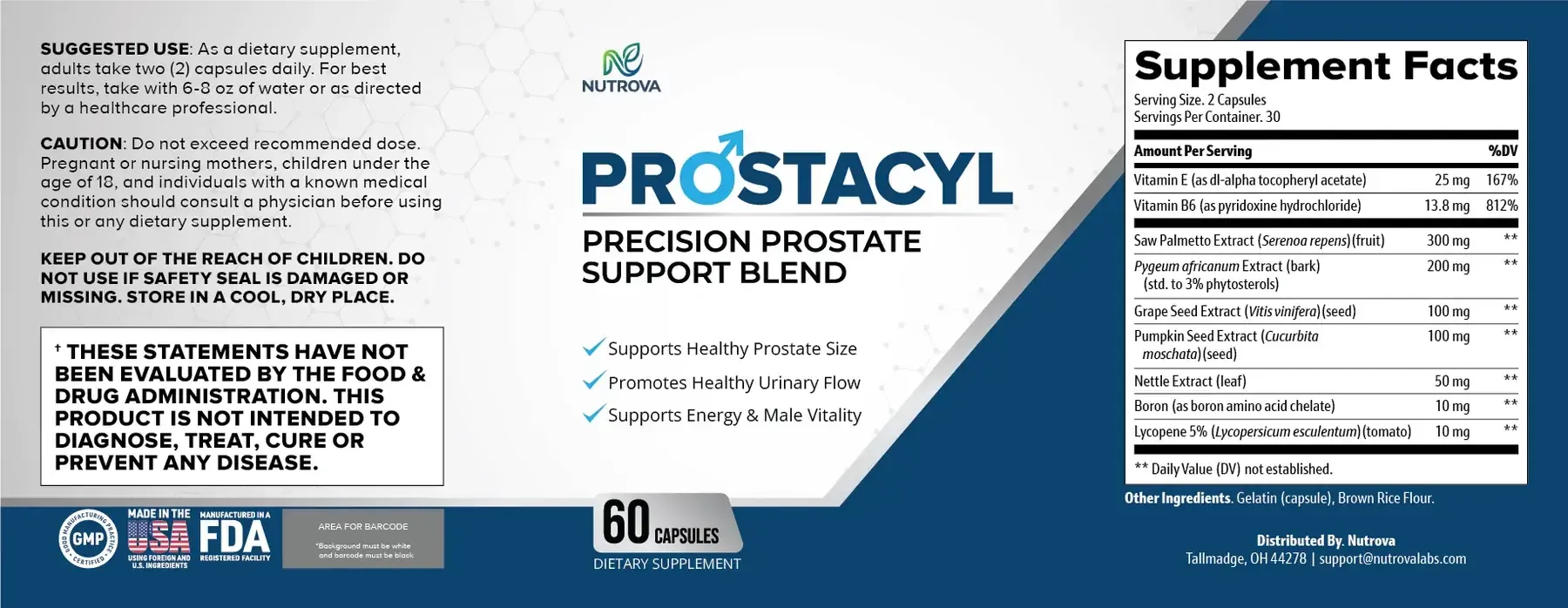
Vitamin B6
13.8 mg of vitamin B6: under the U.S. limit, over the EU limit and Australia's warning line. What to watch for.
Read moreSupplement Facts
The Prostacyl label read line by line: amounts, %DV math, the caution, and the details the bottle leaves out.
Read moreUSA Authorized Prostacyl Retailer
Ready to try Prostacyl?
Pick a pack. Two capsules a day; one bottle lasts 30 days.
- Secure checkout
- 60-day money-back window
- Free U.S. shipping on 3+ bottles