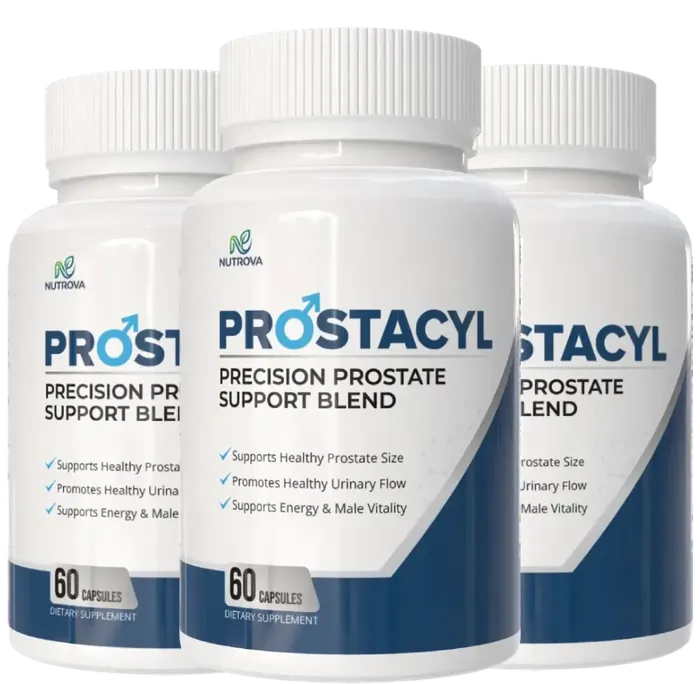
Ingredient profile
Lycopene in Prostacyl: How Much You Get and What Studies Used
Prostacyl prints "Lycopene 5%" at 10 mg per two capsules. By our arithmetic, that is about 0.5 mg of actual lycopene. Small prostate trials gave 15 mg or 30 mg a day (Schwarz 2008: Lycopene in BPH) (Kucuk 2002: Lycopene pilot trial), so the label amount is roughly 1/30th to 1/60th of those doses. Memorial Sloan Kettering and the National Cancer Institute call the evidence mixed (MSK About Herbs: Lycopene) (NCI PDQ: Prostate supplements (patient)).
Written by the Prostacyl editorial teamUpdated
The basics
What is lycopene, and why is it in Prostacyl?
Lycopene is the red pigment in tomatoes. It belongs to a family of plant pigments called carotenoids, the same group as beta-carotene.
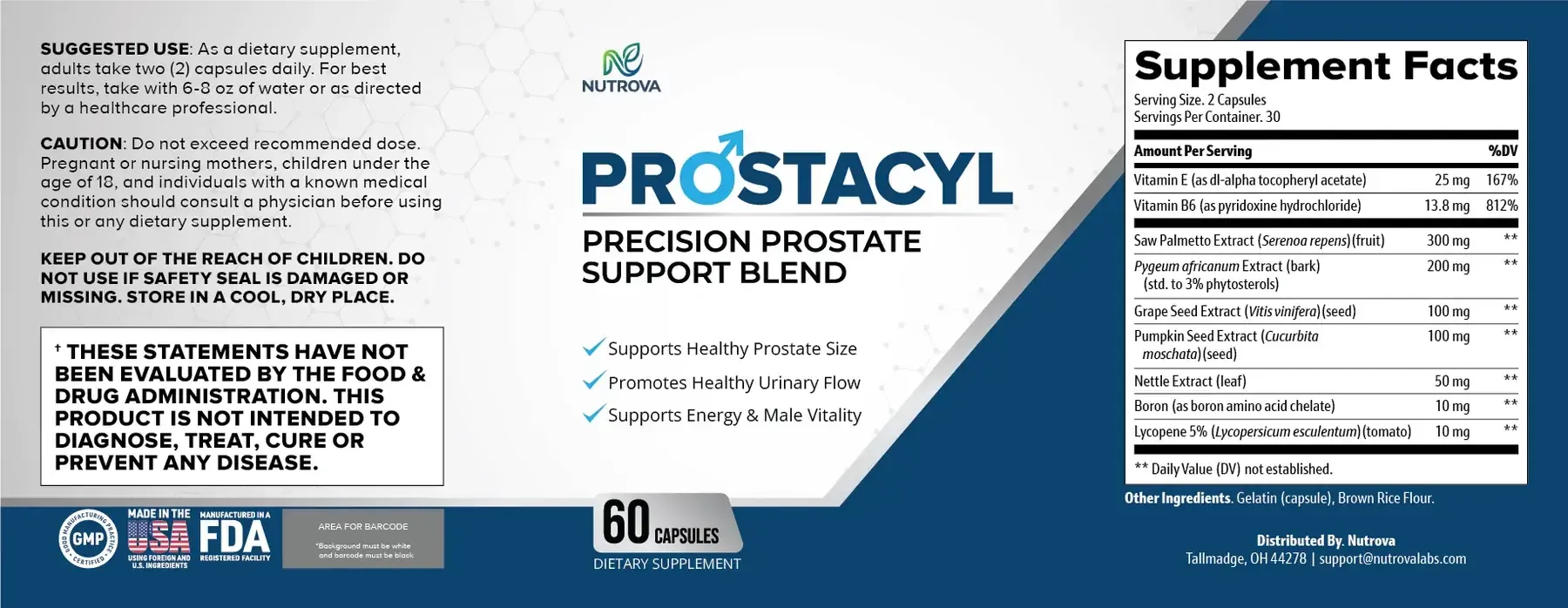
Prostacyl lists it last on the Supplement Facts panel as "Lycopene 5% (Lycopersicum esculentum)(tomato)" at 10 mg. Lycopersicum esculentum is the old botanical name for the tomato plant.
Many men's formulas add it because it has been studied for prostate health for decades. Studied is not the same as shown to work. The research so far is small and does not agree with itself.
Label math
How much lycopene is in a serving of Prostacyl?
About 0.5 mg, if the label means what extract labels usually mean. "5%" describes the strength of the tomato extract, and 5% of 10 mg is 0.5 mg.
| Reading of the label | Lycopene per 2 capsules | Share of a 15 mg trial dose | Share of a 30 mg trial dose |
|---|---|---|---|
| 10 mg of a 5% tomato extract (most likely) | About 0.5 mg | About 3% | About 2% |
| 10 mg of pure lycopene (less likely) | 10 mg | About 67% | About 33% |
Only the brand can confirm which reading is correct. A buyer can ask Nutrova at the email printed on the label, [email protected]. Our Supplement Facts walkthrough covers every other line of the panel.
At a glance
Prostacyl's lycopene in five numbers
Evidence
What did prostate trials of lycopene actually find?
Two small trials reported hopeful signals, and neither was large enough to settle anything. Both gave far more lycopene than Prostacyl's label provides.
Schwarz 2008: 15 mg a day
Men with BPH took 15 mg or a placebo for 6 months. PSA dropped with lycopene. On ultrasound, placebo prostates grew and lycopene ones did not. Symptoms improved in both groups (Schwarz 2008: Lycopene in BPH).
Kucuk 2002: 30 mg a day
Men waiting for prostate surgery took 15 mg twice a day for 3 weeks. PSA fell 18% with lycopene and rose 14% in the control group, but the difference was not statistically significant (Kucuk 2002: Lycopene pilot trial).
A mix that went the wrong way
In 60 high-risk men, a supplement of lycopene, selenium and green tea for 6 months was linked with more prostate cancer on repeat biopsy, the National Cancer Institute reports (NCI PDQ: Prostate supplements (patient)).
None of these studies tested Prostacyl, and none used a dose near 0.5 mg.
Expert summaries
What do MSK and the National Cancer Institute say about lycopene?
Both call the evidence unsettled. The National Cancer Institute says there is "not enough evidence to know whether lycopene can prevent or treat prostate cancer" (NCI PDQ: Prostate supplements (patient)).
Memorial Sloan Kettering's About Herbs service reaches a similar place. It calls the data on lycopene supplements for prostate cancer prevention inconclusive. It also notes that some studies of lycopene or tomato-based plans found no benefit (MSK About Herbs: Lycopene).
MSK does mention small BPH trials with a possible benefit. It adds that "no optimal dosage has been established" (MSK About Herbs: Lycopene).
Lycopene is worth studying but weak to count on. In Prostacyl the amount is small, and no one has measured what it does.
Food first
Can you get more lycopene from tomato foods than from Prostacyl?
Yes, easily. Even a small serving of cooked tomato sauce usually holds more lycopene than 0.5 mg.
The National Cancer Institute names tomato products as the main U.S. source. It adds that processed tomato foods such as paste and puree are absorbed better than raw tomatoes (NCI PDQ: Prostate supplements (patient)). MSK lists watermelon, guava and pink grapefruit as other sources (MSK About Herbs: Lycopene).
- Tomato paste, puree and pasta sauce: the richest everyday sources, and the best absorbed.
- Tomato soup and tomato juice: easy to fit into a lunch.
- Watermelon and pink grapefruit: red fruit with lycopene and no cooking needed.
- Pair tomato foods with a little olive oil; lycopene is fat-soluble, so a meal with some fat helps.
A man who eats tomato sauce a few times a week gets little extra lycopene from Prostacyl.
Safety
Is the lycopene in Prostacyl safe to take?
At about 0.5 mg a day, lycopene is unlikely to cause problems. The amount is smaller than what many people eat.
MSK notes one odd effect: very large intakes of tomato products can turn the skin orange, a condition called lycopenemia (MSK About Herbs: Lycopene). That is not a concern at this dose.
Quality is a fair question for any lycopene product. MSK reports a review of six brands in which measured lycopene missed the label figure by as much as 43% (MSK About Herbs: Lycopene). Prostacyl publishes no lab test for its tomato extract.
A weak stream, sudden urges and night trips have several possible causes, from BPH to infection, bladder trouble or cancer. See a doctor about urinary symptoms before relying on any supplement (NIDDK: Prostate enlargement (BPH)). Our PSA test explainer covers what to ask.
Our view
Is the lycopene in Prostacyl worth anything?
As a prostate ingredient, probably not much at this amount. It is a small extra, not a reason to buy.
Pros
- The amount and the 5% strength are both printed
- Very low risk at about 0.5 mg
- The label names its source: tomato
Cons
- Roughly 1/30th of the smallest trial dose
- Evidence is mixed even at full trial doses
- Tomato foods supply more for less money
The strongest-studied ingredient on the label is pygeum, at 200 mg. See all nine side by side on the ingredients overview.
| Label name | Lycopene 5% (Lycopersicum esculentum) (tomato) |
|---|---|
| What it is | Tomato extract, 5% lycopene · Carotenoid |
| Position on the label | Printed with its own amount |
| Amount per serving (2 capsules) | 10 mg of a 5% extract, printed (about 0.5 mg lycopene) |
| Amount used in research | 15-30 mg of lycopene a day in small prostate trials |
| Strength of evidence | Mixed; not enough to know |
| Why it is used | The red pigment in tomatoes |
| Main caution | Generally well tolerated; a cooked-tomato serving often holds more. |
FAQ
Lycopene in Prostacyl: common questions
Is 0.5 mg of lycopene enough to make a difference?
Probably not, based on current research. The trials that reported hopeful signals used 15 mg or 30 mg a day (Schwarz 2008: Lycopene in BPH) (Kucuk 2002: Lycopene pilot trial), which is 30 to 60 times more. Our 0.5 mg figure comes from the label's 5% strength; only Nutrova can confirm the exact amount.
What does "Lycopene 5%" mean on a supplement label?
It usually means the tomato extract is standardized to contain 5% lycopene by weight. So 10 mg of extract carries about 0.5 mg of lycopene itself. The rest is other tomato material.
Does lycopene help an enlarged prostate?
The evidence is too thin to say. One trial of 40 men with BPH reported lower PSA and no prostate growth at 15 mg a day for 6 months (Schwarz 2008: Lycopene in BPH). MSK calls such results small trials suggesting a possible benefit, with no established dose (MSK About Herbs: Lycopene).
Can lycopene lower the risk of prostate cancer?
Nobody knows yet. In the National Cancer Institute's summary, the evidence is too thin to tell whether lycopene can prevent or treat prostate cancer (NCI PDQ: Prostate supplements (patient)). In one study of 60 high-risk men, a lycopene, selenium and green tea mix was linked with more cancer, not less.
Is it better to eat tomatoes than take a lycopene capsule?
For lycopene alone, tomato foods usually win on amount and price. The National Cancer Institute says paste and puree are absorbed better than raw tomatoes (NCI PDQ: Prostate supplements (patient)). A small serving of cooked sauce typically supplies more lycopene than Prostacyl's roughly 0.5 mg, plus fiber and potassium.
Can too much lycopene turn your skin orange?
Yes, but only with very large intakes of tomato products over time. MSK calls the condition lycopenemia (MSK About Herbs: Lycopene). At about 0.5 mg a day, the lycopene in Prostacyl is far too little to cause it.
Who wrote this
Written and reviewed by
Plain-language pages built from the bottle label, the order page and linked public health sources such as NIH, FDA and CDC.
Last updated . Read our editorial standards and how we check reviews. This website is run by a USA authorized Prostacyl retailer, not by the manufacturer. We earn money when you buy through our order links.
Keep reading
More about Prostacyl
Supplement Facts
The Prostacyl label read line by line: amounts, %DV math, the caution, and the details the bottle leaves out.
Read moreVitamin E
25 mg of synthetic vitamin E: above the RDA, about a seventh of the SELECT dose that raised prostate cancer risk.
Read more
PSA test basics
What PSA measures, who should test, what else raises it, and why your doctor needs your supplement list.
Read moreUSA Authorized Prostacyl Retailer
Ready to try Prostacyl?
Pick a pack. Two capsules a day; one bottle lasts 30 days.
- Secure checkout
- 60-day money-back window
- Free U.S. shipping on 3+ bottles