How it works
How Does Prostacyl Work? Ingredient by Ingredient
Prostacyl is meant to work through nine printed ingredients, taken as two capsules a day.
Pygeum at 200 mg is the herb that sits inside a studied range. Saw palmetto at 300 mg is the largest herb, joined by grape seed, pumpkin seed, nettle leaf, lycopene, vitamins E and B6 and boron.
For the daily routine, see how to take it.
Written by the Prostacyl editorial teamUpdated
The idea
What is Prostacyl designed to do?
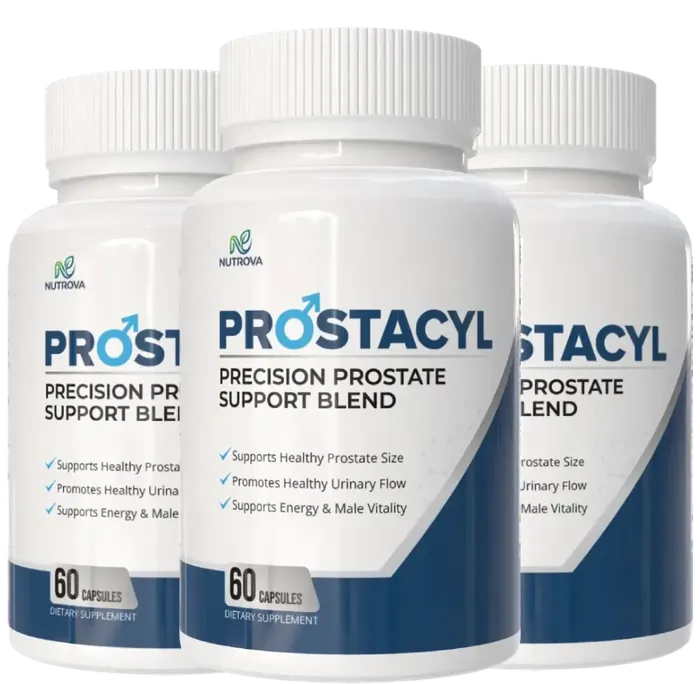
Prostacyl is designed as a daily prostate support supplement. It puts nine ingredients into two gelatin capsules, and the label prints the amount of every one.
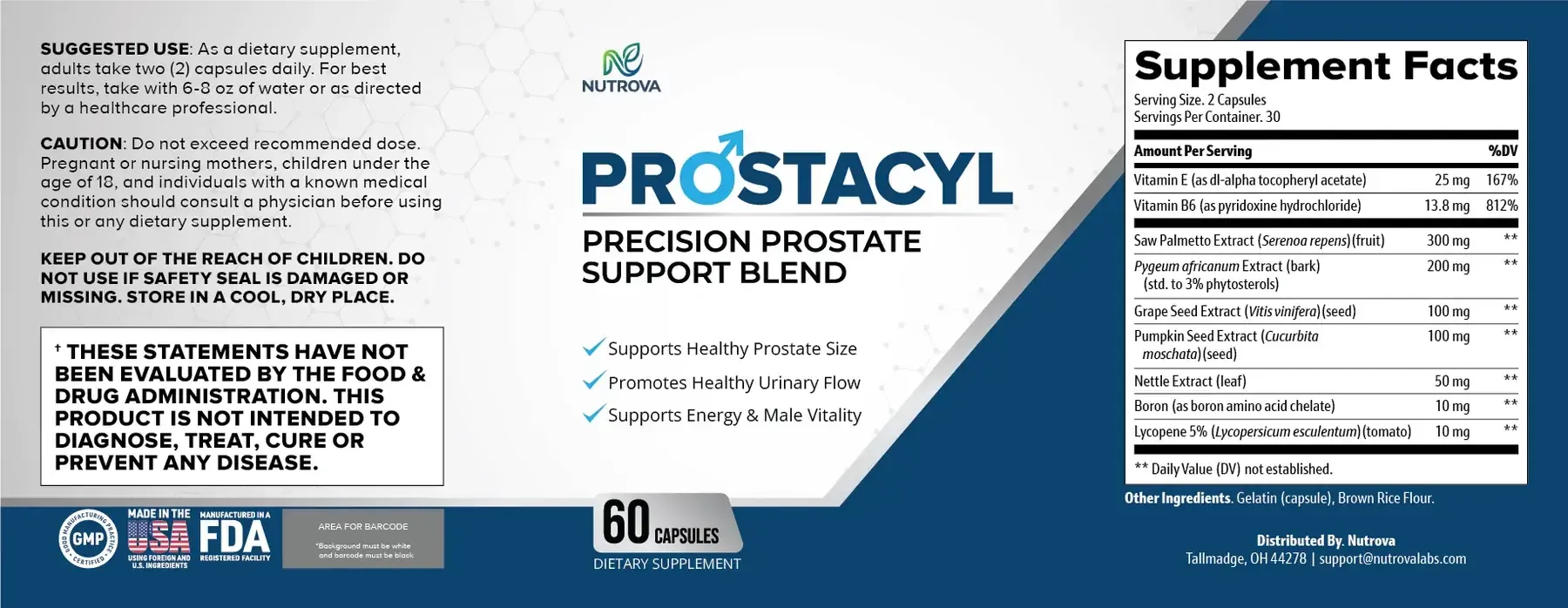
The front of the bottle calls it a "Precision Prostate Support Blend". Inside are five plant extracts, two vitamins, one mineral and a tomato extract. Saw palmetto and pygeum are the two largest herbs, at 300 mg and 200 mg.
Prostacyl has not been tested as a finished product. So the only fair way to judge it is ingredient by ingredient, at the doses studies used.
Four steps
How do you put Prostacyl to work, step by step?
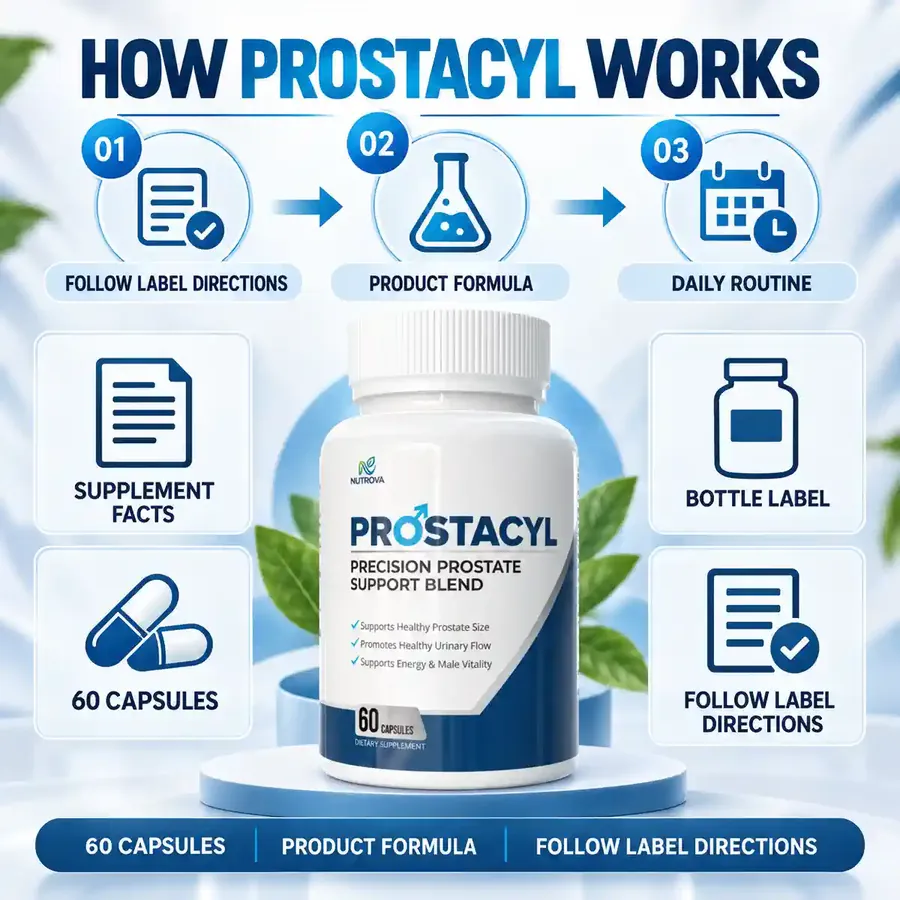
Get checked, read the label, take two capsules, and judge it inside the money-back window.
- 01
Get checked first
Weak flow and night trips can come from BPH, infection or cancer. A doctor visit sorts out which.
- 02
Read the label
Nine printed amounts. Check the B6, boron and herbs against your medicines and other supplements.
- 03
Take two capsules
Two a day with 6-8 oz of water, at the same time each day. Never more.
- 04
Judge it inside 60 days
Track night trips and flow weekly. Ask for a refund inside the 60-day window if it is not for you.
Ingredient by ingredient
What was each Prostacyl ingredient studied for?
Only four of the nine ingredients have been studied for urinary symptoms in men. The rest were studied for other things, or not for the prostate at all.
| Ingredient | Studied for | Amount studied | One serving holds |
|---|---|---|---|
| Saw palmetto | Urinary symptoms of BPH | 320 mg a day; up to 960 mg in CAMUS (CAMUS: Saw palmetto doses and PSA) | 300 mg |
| Pygeum | Urinary symptoms of BPH | 75-200 mg a day (RxList: Pygeum) | 200 mg |
| Pumpkin seed | Urinary symptoms of BPH | Extract 1,000 mg a day; seeds 10 g a day (GRANU trial: Pumpkin seed (2015)) | 100 mg of extract |
| Nettle | Root: BPH. Leaf: hay fever and joints | No prostate dose for the leaf | 50 mg of leaf |
| Lycopene | BPH and prostate cancer, small trials | 15-30 mg a day (Schwarz 2008: Lycopene in BPH) | About 0.5 mg |
| Grape seed | Cholesterol and blood pressure | Not studied for the prostate | 100 mg |
| Vitamin E | Cancer prevention (SELECT) | 400 IU, about 180 mg (NIH ODS: Vitamin E) | 25 mg |
| Vitamin B6 | General nutrition | RDA 1.7 mg for men over 50 | 13.8 mg |
| Boron | Diet surveys; no prostate trials | Diet gives about 1-1.5 mg (NIH ODS: Boron) | 10 mg |
The lycopene figure is our arithmetic: 10 mg of a 5% tomato extract is about 0.5 mg of lycopene.
Dose check
Are Prostacyl's doses close to the research?
One herb sits in range. Several sit far below it.
Saw palmetto is the closest match on paper. Its 300 mg is just under the 320 mg used in most trials. The catch is that those trials mostly failed. CAMUS tripled the dose to 960 mg over 72 weeks and still found no benefit over placebo (NCCIH: Saw palmetto).
Pumpkin seed shows the widest gap. Prostacyl's 100 mg is one tenth of the extract dose in the GRANU trial, and that full dose did no better than placebo (GRANU trial: Pumpkin seed (2015)).
Strongest evidence
Which Prostacyl ingredient has the strongest evidence?
Pygeum has the strongest evidence of the nine. A 2002 Cochrane review pooled 18 trials with 1,562 men and found pygeum users were about twice as likely to report symptom relief (Cochrane 2002: Pygeum africanum for BPH).
In that review, night-time urination fell by 19% and peak flow rose by 23%. Side effects were mild and close to placebo.
There are real limits. The trials were small and short, about 64 days on average, with mixed preparations. Long-term safety is not well known (MSK About Herbs: Pygeum).
Prostacyl's 200 mg sits at the top of the 75-200 mg studied range. Its extract is standardized to 3% phytosterols, a different standard from most trials. The pygeum ingredient page has the detail.
Vitamins and minerals
What do the vitamins and boron in Prostacyl add?
No study shows a prostate benefit from the vitamin E, vitamin B6 or boron amounts in Prostacyl. They are nutrients, and each sits above normal daily needs.
Above the RDA, far below SELECT
The RDA is 15 mg. SELECT gave 400 IU of the same synthetic form and saw 17% more prostate cancers (NCI: SELECT trial results Q&A).
About 8 times the RDA
Under the U.S. 100 mg upper limit. Above the 12 mg limit set in Europe. Australia requires a nerve warning on products above 10 mg a day (TGA: Vitamin B6 safety update).
Many times a normal diet
A typical U.S. diet gives about 1-1.5 mg a day. One serving supplies half of the 20 mg adult upper limit.
Label claims
What do Prostacyl's label claims and FDA statement mean?
The three front-label claims are structure/function claims, not health promises. The FDA does not approve supplements or their claims before they go on sale (FDA: Q&A on dietary supplements).
| "Supports Healthy Prostate Size" | No ingredient at these doses has shown a change in prostate size in a large trial. Short saw palmetto trials found no effect on size (LiverTox: Saw palmetto). |
|---|---|
| "Promotes Healthy Urinary Flow" | Pygeum trials reported better flow, in small short studies. Saw palmetto did not beat placebo. |
| "Supports Energy & Male Vitality" | No ingredient was studied for energy or vitality at these amounts. |
The label carries the required notice: "These statements have not been evaluated by the Food and Drug Administration. This product is not intended to diagnose, treat, cure or prevent any disease." Makers must hold evidence for such claims, but the FDA does not review it first (FDA: Structure/function claims).
Plain answer
Is Prostacyl a BPH medicine?
No. Prostacyl is sold as a dietary supplement and works under supplement rules, not drug rules. It does not treat, shrink or cure an enlarged prostate, and it does not prevent prostate cancer.
BPH medicines such as alpha blockers are prescription drugs (Urology Care Foundation: BPH). If you take one, keep taking it as prescribed.
Weak flow, urgency and night trips can come from BPH, an infection, a bladder problem or prostate cancer. A doctor visit finds which one is behind your symptoms.
Being unable to urinate, blood in the urine, fever with painful urination, or strong pain in the lower belly needs prompt medical care (NIDDK: Prostate enlargement (BPH)).
Realistic
What should you realistically expect from Prostacyl?
- Nine ingredients, each with a printed amount and no hidden blend
- One herb, pygeum, at a studied dose with modest short-term support
- Saw palmetto near a dose that failed in large trials
- No trial of Prostacyl itself, and no drug effect
- A fair test inside the 60-day money-back window
FAQ
How Prostacyl works: FAQ
How is Prostacyl supposed to work for the prostate?
Prostacyl is meant to work through its nine ingredients, mainly saw palmetto and pygeum, taken as two capsules a day. Only pygeum at 200 mg matches a studied dose with modest support from small trials (Cochrane 2002: Pygeum africanum for BPH). No study has tested Prostacyl as a finished product.
Is Prostacyl a drug or a dietary supplement?
Prostacyl is a dietary supplement sold under supplement rules, not a drug. The FDA does not approve supplements before sale, and the label says its claims have not been evaluated by the FDA (FDA: Q&A on dietary supplements). It is not a substitute for any prostate medicine.
Should I stop my BPH pills once I start Prostacyl?
No. Keep taking alpha blockers or finasteride exactly as prescribed, because no study compares Prostacyl with them. Talk to your doctor before adding any supplement, since your doctor should know every prostate product you use.
Do the vitamins in Prostacyl do anything for the prostate?
Not that any study shows. The vitamin E, vitamin B6 and boron amounts sit above daily needs, but none has a proven prostate benefit. In the SELECT trial, a much larger vitamin E dose raised prostate cancer risk by 17% (JAMA 2011: Vitamin E and prostate cancer).
Why does Prostacyl contain so little pumpkin seed and lycopene?
The label gives no reason. Its 100 mg pumpkin seed extract is a tenth of a trial dose that did not beat placebo (GRANU trial: Pumpkin seed (2015)). Its lycopene works out to about 0.5 mg, against 15-30 mg used in small prostate trials (Schwarz 2008: Lycopene in BPH).
Does the nettle in Prostacyl work like nettle root?
Not as far as anyone knows. Prostacyl uses 50 mg of nettle leaf, and prostate research used the root, which contains different compounds (WebMD: Stinging nettle). Root results cannot be carried over to the leaf, so the nettle here has no prostate evidence of its own.
Who wrote this
Written and reviewed by
Plain-language pages built from the bottle label, the order page and linked public health sources such as NIH, FDA and CDC.
Last updated . Read our editorial standards and how we check reviews. This website is run by a USA authorized Prostacyl retailer, not by the manufacturer. We earn money when you buy through our order links.
Keep reading
More about Prostacyl
Ingredients
All nine Prostacyl ingredients, each printed amount set beside the dose research used, with a plain verdict.
Read moreSupplement Facts
The Prostacyl label read line by line: amounts, %DV math, the caution, and the details the bottle leaves out.
Read moreBenefits
Each Prostacyl label claim set beside the evidence, ingredient by ingredient, with an honest grade.
Read moreUSA Authorized Prostacyl Retailer
Ready to try Prostacyl?
Pick a pack. Two capsules a day; one bottle lasts 30 days.
- Secure checkout
- 60-day money-back window
- Free U.S. shipping on 3+ bottles