Ingredient 5 of 9
Grape Seed Extract in Prostacyl: What It Was Studied For, and What It Was Not
Each 2-capsule serving of Prostacyl lists 100 mg of grape seed extract. NCCIH says grape seed extract has not been studied for prostate health; well-controlled human studies mainly cover cholesterol and blood pressure, with small, partial results (NCCIH: Grape seed extract). It is generally well tolerated, but it may interact with blood thinners such as warfarin (UC San Diego Health: Grape seed extract).
Written by the Prostacyl editorial teamUpdated
The basics
What is the grape seed extract in Prostacyl?
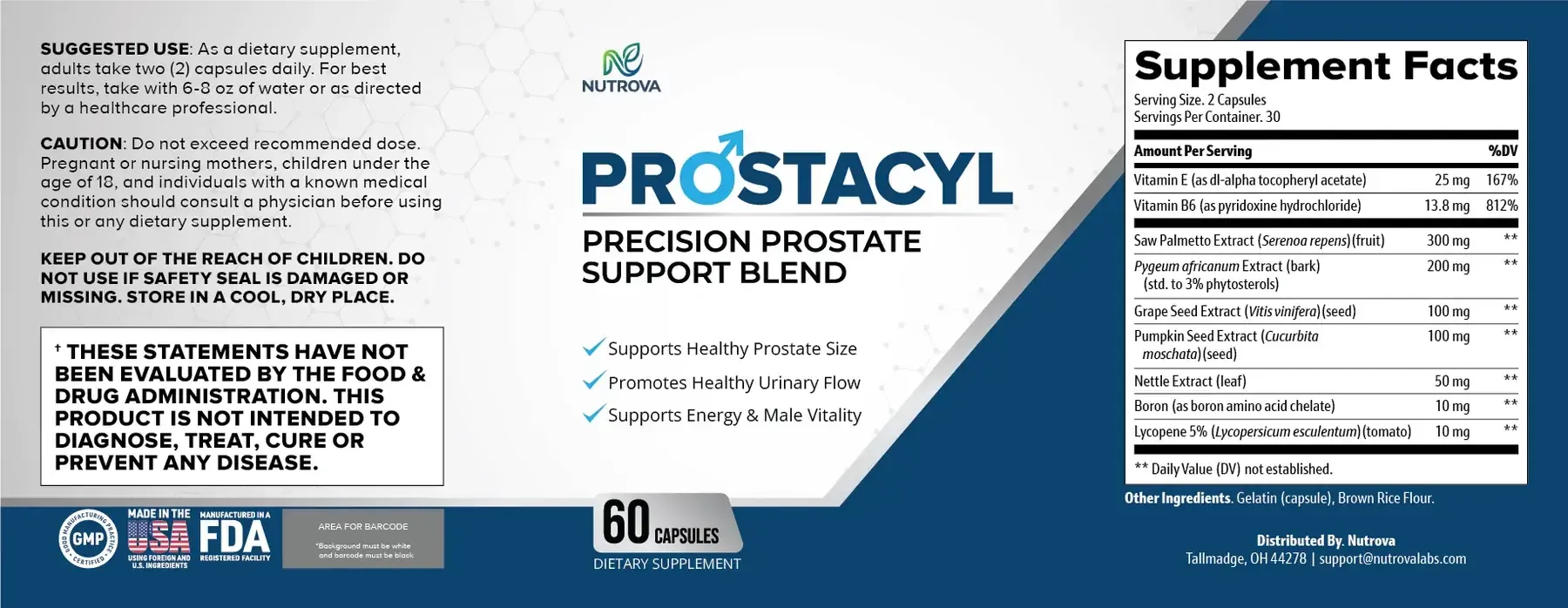
It is a powder made from the seeds of wine grapes, Vitis vinifera. Prostacyl lists "Grape Seed Extract (Vitis vinifera)(seed)" at 100 mg per 2-capsule serving.
Grape seeds are rich in plant compounds called proanthocyanidins. These are the reason grape seed extract is sold, usually as an antioxidant.
Grape seed extract is a by-product of a familiar food. The seeds are left over from wine and juice making. It is a common ingredient in antioxidant blends.
Many grape seed products state what share of the powder is proanthocyanidins. The Prostacyl label does not. So you know the weight of the extract, but not how much of the active compounds it carries.
The research
What has grape seed extract been studied for?
Mainly cholesterol and blood pressure. NCCIH, part of the National Institutes of Health, says these are the topics of the well-controlled human studies, in its February 2025 fact sheet (NCCIH: Grape seed extract).
| Topic | Review | Possible benefit | No clear benefit |
|---|---|---|---|
| Cholesterol | 2020: 11 studies, 536 people | LDL ("bad") cholesterol and triglycerides | Total and HDL ("good") cholesterol |
| Blood pressure | 2022: 19 studies, 1,080 people | Diastolic (the lower number) | Systolic (the upper number) |
| Prostate health | Not studied | Not published | Not published |
Both reviews found a benefit on one measure and none on the other. That is a partial result, not a clear win.
Reading the results
What do the grape seed blood pressure and cholesterol results mean?
They hint at small effects on heart-health numbers, nothing more. A blood pressure reading has two numbers; the 2022 review saw a drop in the lower one only (NCCIH: Grape seed extract).
- Diastolic pressure: the pressure between heartbeats. Lower in the review.
- Systolic pressure: the pressure as the heart pumps. No change.
- LDL and triglycerides: a possible drop in the 2020 review.
- HDL and total cholesterol: no change.
None of this was measured in Prostacyl, and none of it is about the prostate. If your blood pressure or cholesterol is high, keep taking what your doctor prescribed. A supplement is not a substitute.
Prostate
Has grape seed extract been studied for the prostate?
No. NCCIH states plainly that grape seed extract has not been studied for prostate health (NCCIH: Grape seed extract). We found no trial of grape seed extract for urinary symptoms or BPH among our sources.
So its place in a "prostate support blend" rests on its general antioxidant appeal, not on prostate research. The label does not explain why it was included.
Grape seed sits in the same group as nettle leaf: no prostate study to measure against. Pygeum is the only plant extract in Prostacyl with a studied dose and positive trials behind it.
Dose check
Is 100 mg of grape seed extract a typical amount?
There is no agreed dose to judge it by. UC San Diego Health gives no standard dose for grape seed extract, and the NCCIH fact sheet lists none for the reviews it cites (NCCIH: Grape seed extract) (UC San Diego Health: Grape seed extract).
Without a dose range, there is no way to call 100 mg low or high. Without a proanthocyanidin figure, there is no way to compare two products either. That leaves 100 mg with nothing firm to compare against. For a prostate goal, the dose question is moot anyway, because no prostate dose was ever tested. If you want to see how the other eight printed amounts line up with research, the Supplement Facts breakdown sets them out one by one.
Safety
Is grape seed extract safe with blood thinners?
Ask first. UC San Diego Health says grape seed extract may interact with blood thinners such as warfarin, and with some medicines the liver clears through particular enzymes (UC San Diego Health: Grape seed extract). NCCIH says it is generally well tolerated by mouth, and advises talking to a provider first if you take any medicine (NCCIH: Grape seed extract).
| Topic | What the sources say |
|---|---|
| Side effects | "Not known to cause any side effects" (UC San Diego Health); generally well tolerated (NCCIH) |
| Blood thinners | May interact with warfarin and similar drugs (UC San Diego Health: Grape seed extract) |
| Liver-cleared medicines | May interact with drugs processed by cytochrome P450 3A4 and UGT enzymes (UC San Diego Health: Grape seed extract) |
| Pregnancy and children | Safety poorly understood; UC San Diego Health says they should not use it |
Prostacyl pairs grape seed with saw palmetto, which also carries a bleeding caution (MSK About Herbs: Saw palmetto). If you take warfarin, clopidogrel or another blood thinner, show the label to your doctor or pharmacist before starting. More on combined risks is on the Prostacyl side effects page.
Our take
Is the grape seed extract in Prostacyl worth it?
Not for the prostate. It is a well-tolerated ingredient with modest heart-health data, placed in a formula sold for urinary comfort.
In its favor
- Amount and plant part printed
- Generally well tolerated
- Some data on LDL and diastolic pressure
Against it
- Never studied for the prostate
- No proanthocyanidin content printed
- Possible warfarin interaction
Profile and other ingredients
Grape seed extract at a glance, and the other ingredients
A quick profile of the label line, the research and the main caution, followed by links to the rest of the formula.
| Label name | Grape Seed Extract (Vitis vinifera) (seed) |
|---|---|
| What it is | Vitis vinifera seed · Seed extract |
| Position on the label | Printed with its own amount |
| Amount per serving (2 capsules) | 100 mg, printed |
| Amount used in research | Not studied for the prostate; human trials look at blood pressure and cholesterol |
| Strength of evidence | No prostate studies |
| Why it is used | A source of plant compounds called proanthocyanidins |
| Main caution | May interact with blood thinners such as warfarin. |
FAQ
Grape seed extract in Prostacyl: common questions
Is grape seed extract good for the prostate?
There is no evidence either way, because it has not been studied for prostate health. NCCIH says human studies mainly looked at cholesterol and blood pressure. Its place in Prostacyl is not backed by prostate research.
Does grape seed extract lower blood pressure?
Possibly a little, and only the lower number. A 2022 review of 19 studies with 1,080 people, reported by NCCIH, found lower diastolic but not systolic pressure. Do not swap it for a prescribed blood pressure medicine.
Does grape seed extract help cholesterol?
A 2020 review of 11 studies with 536 people found a possible benefit for LDL cholesterol and triglycerides, according to NCCIH. It found no benefit for total or HDL cholesterol.
Can I take grape seed extract if I am on a blood thinner?
Get a pharmacist's or doctor's go-ahead before the first capsule. UC San Diego Health says grape seed extract may interact with blood thinners such as warfarin. Prostacyl also contains saw palmetto, which carries a bleeding caution, so the label should be checked as a whole.
Does grape seed extract have side effects?
Few are known. UC San Diego Health says it is not known to cause any side effects, and NCCIH calls it generally well tolerated by mouth. The main concerns are drug interactions and use in pregnancy or by children.
How much grape seed extract is in Prostacyl?
The label prints 100 mg per 2-capsule serving, from the seed of Vitis vinifera grapes. It does not state the proanthocyanidin content, and no standard grape seed dose exists to compare it with.
Who wrote this
Written and reviewed by
Plain-language pages built from the bottle label, the order page and linked public health sources such as NIH, FDA and CDC.
Last updated . Read our editorial standards and how we check reviews. This website is run by a USA authorized Prostacyl retailer, not by the manufacturer. We earn money when you buy through our order links.
Keep reading
More about Prostacyl
Saw palmetto
Saw palmetto is printed at 300 mg, near trial doses, but large trials found it no better than placebo.
Read more
Side effects
Ingredient side effects, blood thinner and nettle interactions, B6 nerve signs and the urinary signs that need urgent care.
Read more
Choosing a prostate supplement
Eight label and seller checks for any prostate supplement, with an honest Prostacyl scorecard.
Read moreUSA Authorized Prostacyl Retailer
Ready to try Prostacyl?
Pick a pack. Two capsules a day; one bottle lasts 30 days.
- Secure checkout
- 60-day money-back window
- Free U.S. shipping on 3+ bottles