Guide
Enlarged Prostate (BPH) Guide: Signs, Tests, Care and Where Prostacyl Fits
BPH is a prostate that has grown larger than normal without cancer. NIDDK says it affects about 5-6% of men aged 40-64 and 29-33% of men 65 and older (NIDDK: Prostate enlargement (BPH)). Signs include weak flow, urgency and night trips. A doctor checks it with a symptom score, an exam and urine tests. Prostacyl is a supplement, not a BPH medicine.
Written by the Prostacyl editorial teamUpdated
The basics
What is an enlarged prostate (BPH)?
BPH, or benign prostatic hyperplasia, is a prostate that has grown bigger than normal. "Benign" means it is not cancer, as the National Institute of Diabetes and Digestive and Kidney Diseases (NIDDK) explains (NIDDK: Prostate enlargement (BPH)).
The prostate is a walnut-sized gland below the bladder. It wraps around the urethra, the tube that carries urine out. As the gland grows, it can press on that tube, so flow weakens and the bladder works harder.
BPH and prostate cancer can cause some of the same symptoms. That overlap is the main reason a doctor visit comes first.
By age
How common is an enlarged prostate at each age?
It gets much more common with age. NIDDK puts BPH at about 5-6% of men aged 40-64 and 29-33% of men 65 and older, and says it rarely causes symptoms before 40 (NIDDK: Prostate enlargement (BPH)).
| Age group | Share of men with BPH | What it means in practice |
|---|---|---|
| Under 40 | Rarely causes symptoms | Urinary trouble at this age points a doctor toward other causes, such as infection |
| 40-64 | About 5-6% | Roughly 1 man in 17 to 20 |
| 65 and older | About 29-33% | Close to 1 man in 3 |
The Urology Care Foundation, the patient arm of the American Urological Association, adds that risk rises with age and is higher after 50 (Urology Care Foundation: BPH). Common is not the same as harmless, though.
Key numbers
What are the key numbers for BPH?
Symptoms
What are the symptoms of an enlarged prostate?
The main signs are trouble starting, a weak or stop-start stream, and waking at night to urinate. NIDDK also lists dribbling, a feeling the bladder is not empty, urgency, frequency and pain (NIDDK: Prostate enlargement (BPH)).
Weak or slow flow
A thin stream, a slow start, or a flow that stops and starts.
Frequency and urgency
Urology Care lists needing to go every 1 to 2 hours, and sudden urges that are hard to put off (Urology Care Foundation: BPH).
Waking to urinate
Getting up more than twice a night is a sign Urology Care names. Our night urination guide covers other causes.
Discomfort
Pain or burning is not a typical BPH sign and needs a doctor's look (Urology Care Foundation: BPH).
None of these signs is specific to BPH. Infection, an overactive bladder, diabetes, some medicines and prostate cancer can produce the same list.
Act fast
When is an enlarged prostate an emergency?
It becomes urgent when you cannot pass urine at all. NIDDK lists three more reasons to get care right away: painful, frequent and urgent urination with fever and chills, blood in the urine, and great pain in the lower belly or urinary tract (NIDDK: Prostate enlargement (BPH)).
Go to urgent care or an emergency room if you cannot urinate, see blood in your urine, have a fever with urinary pain, or feel severe pain low in your belly. A full bladder that will not drain can damage the kidneys. No supplement belongs in this picture.
Urology Care gives the same advice in plain terms: see a doctor right away for blood in the urine, pain or burning, or if you cannot pass urine (Urology Care Foundation: BPH).
Short of an emergency, book a normal visit when symptoms bother you or change quickly.
Diagnosis
How do doctors diagnose an enlarged prostate?
Most visits start with your history and a short symptom questionnaire. Urology Care says diagnosis often begins with the AUA Symptom Score, also called the IPSS, which rates seven urinary symptoms from mild to severe (Urology Care Foundation: BPH).
History and medicines
Your doctor asks when symptoms began, how often you go, and what medicines you take.
Symptom score
The questionnaire turns "it seems worse" into a number you can repeat later.
Physical exam
A digital rectal exam lets the doctor feel the size and surface of the prostate. It takes less than a minute.
Urine test
A urine sample can show infection or blood, both of which change the plan.
The PSA question
A PSA blood test may come up. BPH and prostatitis can raise PSA too, says the National Cancer Institute, so one result is not a diagnosis (NCI: PSA test fact sheet).
For men 55 to 69, the U.S. Preventive Services Task Force calls PSA screening a personal decision to make with a clinician (USPSTF: Prostate cancer screening). Our PSA test explainer walks through the trade-offs.
Care options
How is an enlarged prostate managed?
Care runs from watching and waiting to medicines and procedures. Urology Care says the choice depends on how much symptoms bother you (Urology Care Foundation: BPH).
| Option | What it involves | Often used when |
|---|---|---|
| Active surveillance | Regular check-ins and a repeat symptom score, no treatment yet | Symptoms are mild and not a real bother |
| Daily habits | Changes to drink timing, caffeine and alcohol, and bathroom habits | Alongside any other option |
| Alpha blockers | Prescription medicines that relax muscle around the prostate and bladder neck | Symptoms affect daily life |
| 5-alpha reductase inhibitors | Prescription medicines that act on the hormone behind prostate growth; they work slowly | The gland is clearly enlarged |
| Procedures | Office-based or surgical ways to open the channel through the prostate | Medicines fall short, or problems such as retention develop |
Note that 5-alpha reductase inhibitors lower PSA readings, which your doctor will factor in (NCI: PSA test fact sheet).
We give no advice on named prescription brands; ask your pharmacist about yours.
Supplements
Where does a supplement like Prostacyl fit with BPH?
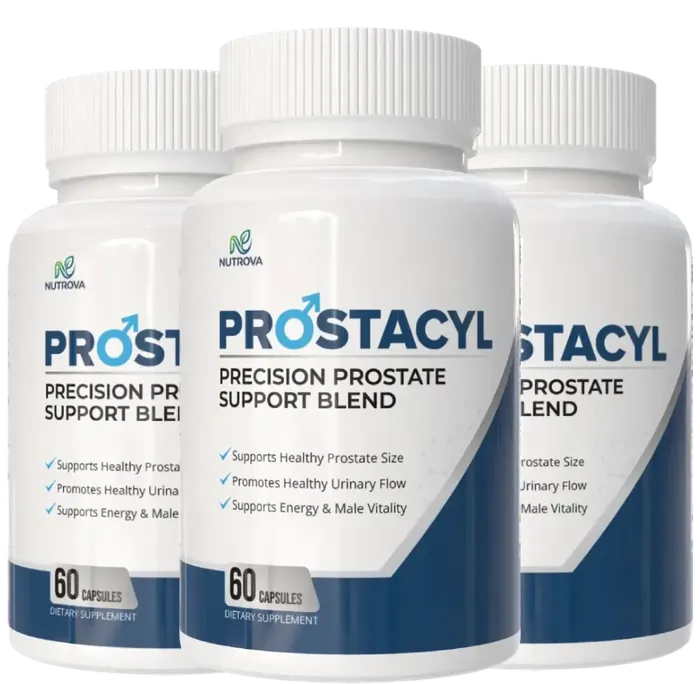
At most as an extra, after a doctor has checked you, and never instead of care. Prostacyl does not treat an enlarged prostate, does not make it smaller, and is not a replacement for any prostate medicine.
The research on its herbs is uneven. Saw palmetto barely moved BPH symptom scores in a 2023 Cochrane review of 27 trials (AFP/Cochrane 2023: Saw palmetto for BPH). Older, short trials of pygeum found modest symptom relief (Cochrane 2002: Pygeum africanum for BPH). Urology Care notes that plant products vary in quality and purity, so providers typically do not recommend them (Urology Care Foundation: BPH).
If you still want to try one, tell your doctor and keep taking anything prescribed. Ask first if you take a blood thinner, since saw palmetto may add to bleeding risk (MSK About Herbs: Saw palmetto). The Prostacyl label breakdown sets each printed amount beside the research.

A sensible order
What order should a man with BPH symptoms follow?
Doctor first, supplement last, and only if it still makes sense. The four steps below put a checkup ahead of any capsule.
- 01
Get checked first
Weak flow and night trips can come from BPH, infection or cancer. A doctor visit sorts out which.
- 02
Read the label
Nine printed amounts. Check the B6, boron and herbs against your medicines and other supplements.
- 03
Take two capsules
Two a day with 6-8 oz of water, at the same time each day. Never more.
- 04
Judge it inside 60 days
Track night trips and flow weekly. Ask for a refund inside the 60-day window if it is not for you.
FAQ
Enlarged prostate (BPH) FAQ
At what age does the prostate usually start to enlarge?
Prostate growth usually shows up after 40, and symptoms become common after 50. NIDDK reports BPH in about 5-6% of men aged 40-64 and 29-33% of men 65 and older, and says it rarely causes symptoms before 40 (NIDDK: Prostate enlargement (BPH)). Urinary trouble in a younger man usually points to another cause.
Can an enlarged prostate turn into cancer?
No. BPH is a benign, non-cancer growth, and it does not turn into prostate cancer. The two conditions can exist at the same time and share symptoms such as weak flow and night trips, so a doctor may still suggest tests to rule cancer out. Ask whether a PSA test makes sense for you.
Is BPH a medical emergency?
Usually not, but it becomes one if you cannot urinate at all. NIDDK also lists blood in the urine, fever and chills with painful urination, and severe pain in the lower belly as reasons to get care right away (NIDDK: Prostate enlargement (BPH)). For everyday symptoms, a normal appointment is the right first step.
Can BPH symptoms improve without medicine?
Mild symptoms sometimes stay stable for years, and Urology Care lists active surveillance as a real option (Urology Care Foundation: BPH). Worsening symptoms, retention or repeated infections usually call for medicine or a procedure, chosen with a doctor. Repeat the symptom score to see which way things are heading.
Do prostate supplements work as well as BPH medicine?
No good evidence says they do. Cochrane's 2023 look at saw palmetto found no meaningful gain over placebo (AFP/Cochrane 2023: Saw palmetto for BPH), and pygeum's older trials were small and short with no direct tests against standard drugs (Cochrane 2002: Pygeum africanum for BPH). Prostacyl is a supplement and not a BPH medicine. Keep prescribed care in place.
Does an enlarged prostate raise PSA?
Yes, it can. The National Cancer Institute says BPH and prostatitis can both raise PSA, as can a recent biopsy, cycling or ejaculation in the two days before the test (NCI: PSA test fact sheet). A raised result calls for a talk, not panic.
Who wrote this
Written and reviewed by
Plain-language pages built from the bottle label, the order page and linked public health sources such as NIH, FDA and CDC.
Last updated . Read our editorial standards and how we check reviews. This website is run by a USA authorized Prostacyl retailer, not by the manufacturer. We earn money when you buy through our order links.
Keep reading
More about Prostacyl
Night urination guide
Why night trips happen, what else besides the prostate causes them, and how a bladder diary helps your doctor.
Read morePSA test basics
What PSA measures, who should test, what else raises it, and why your doctor needs your supplement list.
Read more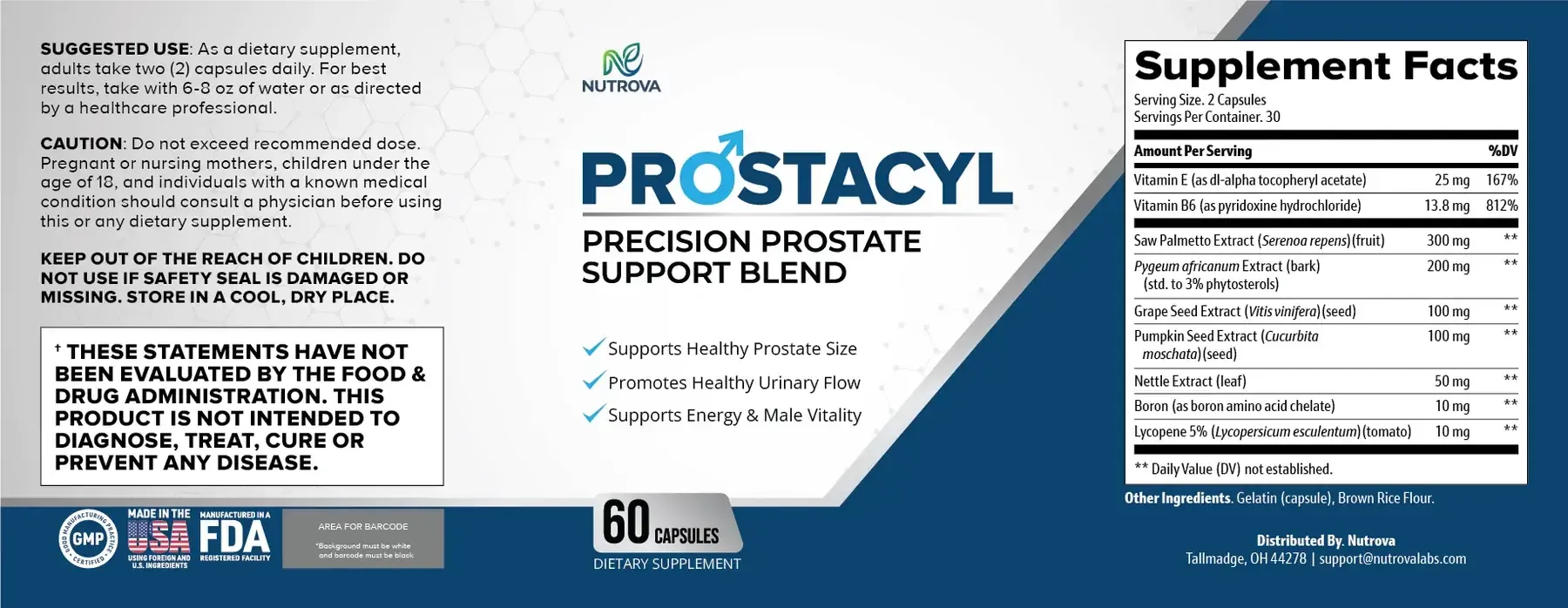
Pygeum
Pygeum is printed at 200 mg, inside the studied range, with modest benefits in small, short trials.
Read moreUSA Authorized Prostacyl Retailer
Ready to try Prostacyl?
Pick a pack. Two capsules a day; one bottle lasts 30 days.
- Secure checkout
- 60-day money-back window
- Free U.S. shipping on 3+ bottles